
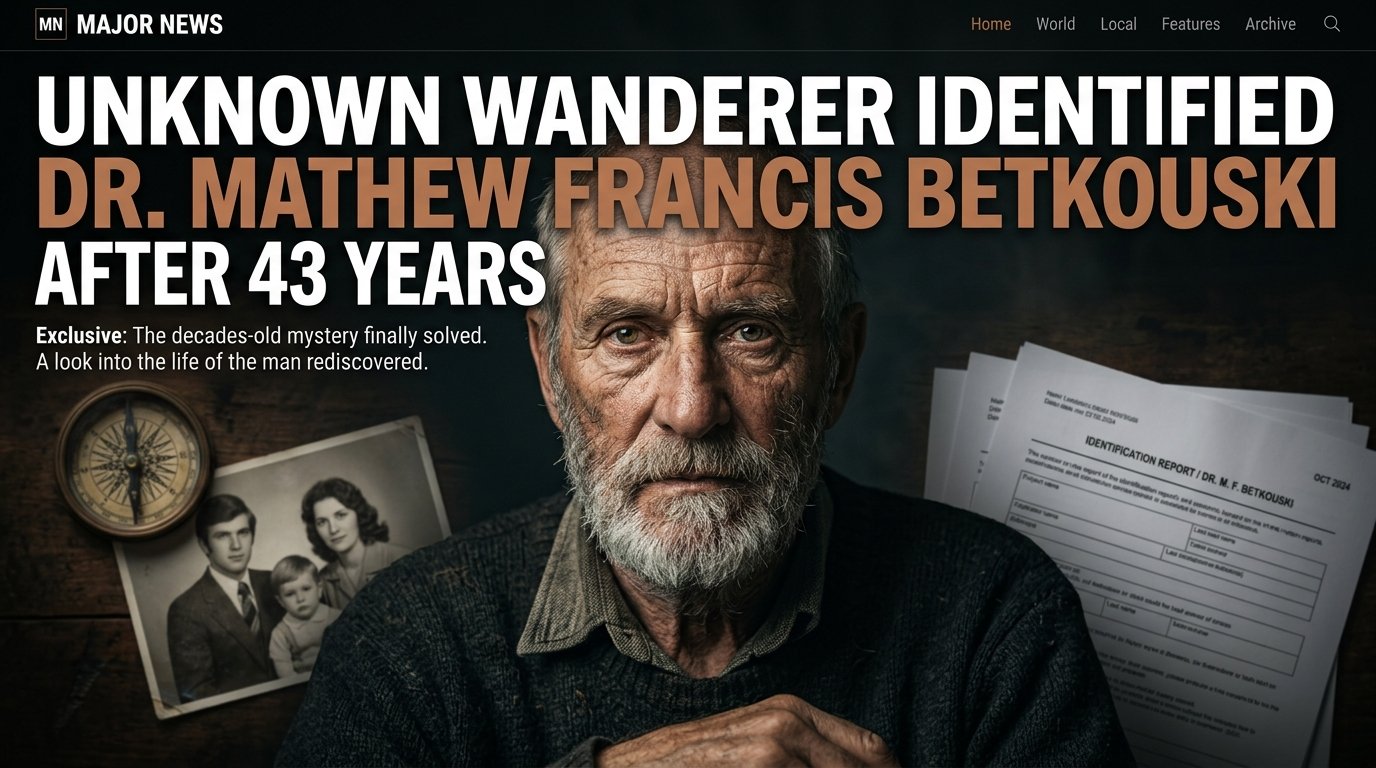
More than four decades after an unidentified man died inside a Boise church, investigators have finally established his identity. The man once known as the “Unknown Wanderer” has been identified as Dr Mathew Francis Betkouski, according to the Ada County Sheriff’s Office.
Authorities announced the identification on Sept. 23, 2026, bringing a major development to a cold case that began in December 1982. The case had also been featured on the television series Unsolved Mysteries.
The investigation took a major turn after Detective Tim Cooper reopened the case in 2019. A set of keys found with the unidentified man eventually helped investigators trace his identity to Jacksonville, Florida.
Who Was the Unknown Wanderer?
The Unknown Wanderer was an unidentified man who died at Sacred Heart Catholic Church in Boise on Dec. 4, 1982.
At the time, investigators could not determine who he was. He carried no identification, and his fingerprints did not produce a match in Idaho or federal databases.
Among his belongings were two key rings containing nearly 30 keys, a wallet without identification cards and an envelope containing $1,900 in cash. Investigators also found a typed note signed with the name “William L. Toomey”, which was later determined to be an alias.
Because authorities could not establish his identity, the man became known publicly as the Unknown Wanderer.
A Key From Jacksonville Helped Break the Case
The breakthrough came years later when Detective Tim Cooper revisited the investigation.
After reopening the case in 2019, Cooper examined the evidence again. One of the keys found among the man’s possessions carried markings that investigators traced to a hardware store in Jacksonville, Florida.
Another marking on the key pointed investigators toward Mills Court in Jacksonville.
Investigators then reviewed historical property records connected to the area. One of the names they found was Mathew Francis Betkouski, a man who had disappeared in 1982 and was later declared dead in 1989.
That discovery gave investigators a potential identity to investigate.
DNA Testing Confirmed Betkouski’s Identity
Investigators eventually located Betkouski’s brother in California.
They obtained a DNA sample from the family and compared it with DNA recovered from belongings associated with the Unknown Wanderer. The testing provided the familial connection investigators needed to establish the man’s identity as Betkouski.
The discovery finally answered one of the central questions surrounding the Boise case: who was the unidentified man who died in 1982?
What Happened to Mathew Francis Betkouski?
According to investigators, Betkouski was an organic chemist with a doctorate and had worked in Florida before later working for Lockheed at its White Sands facility in New Mexico.
Investigators have also described evidence showing that Betkouski had an interest in chemicals and poisons.
However, those details have to be considered in context. Authorities have not established that his interests or professional background prove involvement in any other crime.
His identity was unknown for more than 40 years because investigators had no reliable identification at the time of his death.
Is Betkouski Connected to the 1982 Tylenol Murders?
The identification has also brought renewed attention to the 1982 Chicago Tylenol poisonings, in which seven people died after taking cyanide-laced capsules.
Investigators have said they found information that could potentially connect Betkouski to those events. Evidence reviewed in the investigation reportedly included writings, photographs and other personal materials that raised questions about possible links to Chicago.
However, an important distinction remains.
The Ada County Sheriff’s Office has not officially named Betkouski as a suspect in the Tylenol murders. Detective Tim Cooper said the purpose of releasing the information was to generate additional leads and potentially help investigators examining other cases.
Authorities also have not established that Betkouski was in Chicago during the crucial period when the 1982 poisonings occurred.
Therefore, the possible connection remains an investigative lead rather than a proven conclusion.
Why the Boise Cold Case Matters
The identification of the Unknown Wanderer demonstrates how evidence that appeared unhelpful decades ago can become valuable when investigators revisit a case with newer methods and additional records.
In this investigation, a collection of ordinary keys became an important clue. Historical property records then helped investigators connect those clues to a missing person. Finally, familial DNA testing helped establish the identity.
The case also shows why unidentified-person investigations can remain open for decades. In 1982, investigators had limited information to work with. Modern investigative techniques and renewed examination of old evidence eventually provided a path forward.
The Unknown Wanderer Case Is No Longer an Identity Mystery
For 43 years, the man found dead inside a Boise church was known only by a nickname.
Now, authorities have identified him as Dr Mathew Francis Betkouski.
The discovery closes a major chapter in the identity investigation. At the same time, questions surrounding Betkouski’s activities before his death remain the subject of further investigation, particularly concerning any possible connection to the 1982 Tylenol poisonings.
For now, investigators have drawn a clear line between what has been established and what remains unresolved: Betkouski has been identified as the Unknown Wanderer, but a connection to the Tylenol murders has not been officially established.