
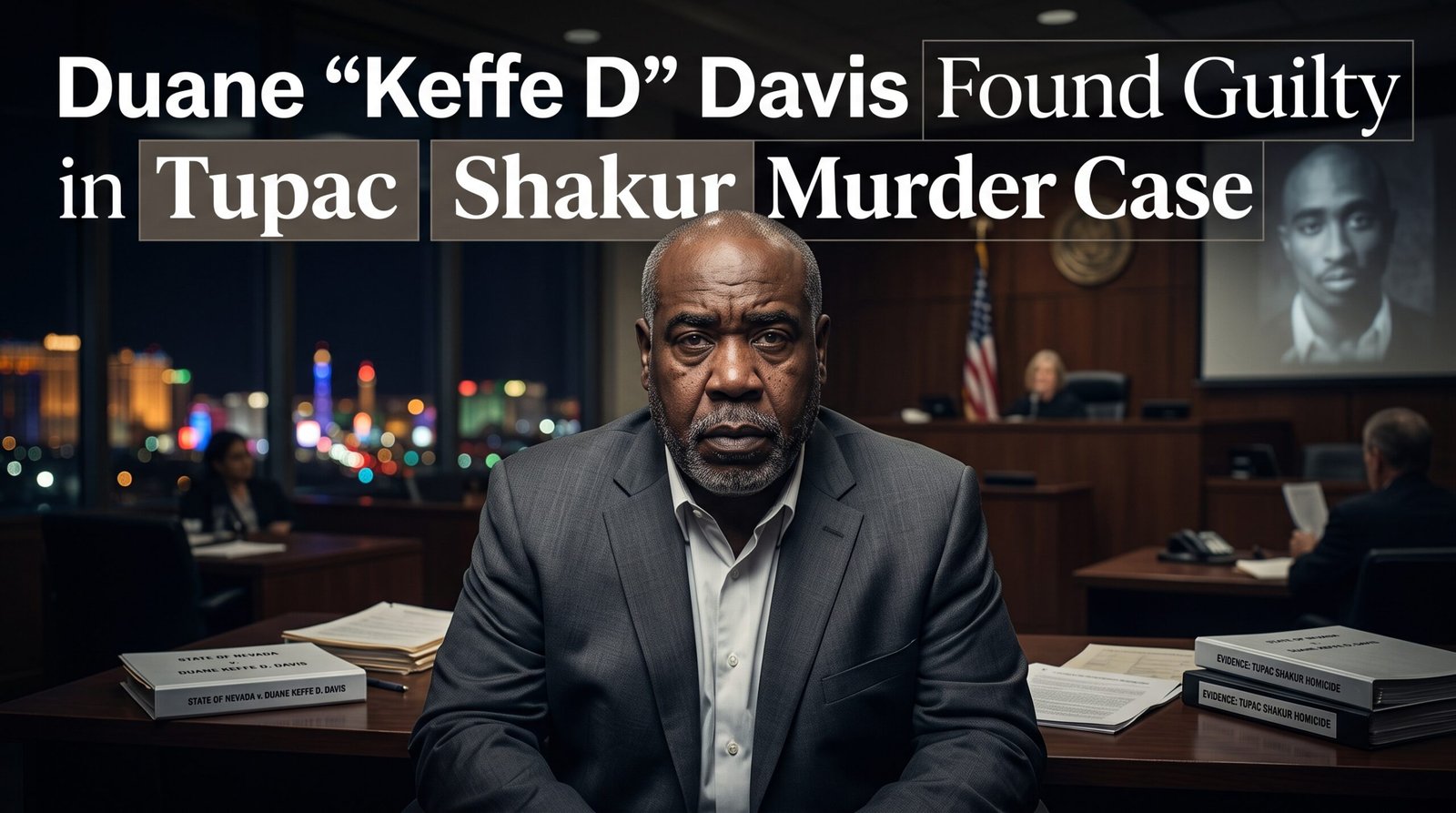
Duane “Keffe D” Davis Found Guilty in Tupac Shakur Murder Case
Nearly three decades after Tupac Shakur was fatally shot in Las Vegas, a jury has found Duane “Keffe D” Davis guilty of murder in the long-running case.
The 63-year-old former gang leader was convicted on August 31, 2026, after jurors deliberated for less than three hours. The verdict marks the first conviction in the 1996 killing of one of hip-hop’s most influential artists.
Davis had pleaded not guilty. Prosecutors argued that he helped organise the shooting after an earlier confrontation involving his nephew, Orlando “Baby Lane” Anderson.
Duane Davis Convicted in Tupac Shakur’s Death
A 12-person jury in Clark County, Nevada, unanimously found Davis guilty of first-degree murder with a deadly weapon. The conviction carries the possibility of a life sentence.
Davis was not accused of being the person who physically fired the fatal shots. Instead, prosecutors presented him as the organiser who helped obtain the weapon and directed the group involved in the attack.
The case was built largely around Davis’ own statements over the years. Prosecutors introduced recorded conversations, interviews and material from his 2019 memoir, Compton Street Legend, as evidence of his involvement.
The defence, meanwhile, argued that Davis had exaggerated or fabricated parts of his stories. His attorneys questioned whether his public statements could be reliably connected to the actual shooting.
What Happened to Tupac Shakur in 1996?
Tupac Shakur was shot on September 7, 1996, while travelling through Las Vegas with Death Row Records executive Marion “Suge” Knight.
A white Cadillac pulled alongside their vehicle near a Las Vegas intersection, and gunfire erupted. Shakur was struck multiple times. Knight was also injured but survived.
Shakur was taken to a hospital but died six days later, on September 13, 1996. He was only 25 years old.
His death became one of the most closely followed unsolved cases in music history.
Why Prosecutors Linked Davis to the Shooting
The prosecution argued that the killing was motivated by an earlier confrontation at the MGM Grand following a Mike Tyson boxing match.
According to prosecutors, Shakur and members of his entourage had been involved in an assault on Orlando Anderson, Davis’ nephew, earlier that night.
Investigators later focused on Davis because of statements he made about the events. His public accounts, memoir and recorded conversations became important parts of the prosecution’s case.
One key piece of evidence was a recording in which Davis discussed being inside the vehicle during the shooting and identified Anderson as the person who fired at Shakur’s vehicle. Prosecutors also argued that Davis had supplied the firearm used in the attack.
However, Anderson died in 1998, and the other men prosecutors associated with the shooting are also deceased. Davis therefore became the only person charged in connection with the killing.
Defense Challenged Davis’ Own Statements
Davis’ defence attempted to weaken the prosecution’s reliance on his past statements.
His lawyers argued that some of his accounts were exaggerated and that he had reasons to embellish his involvement, including publicity surrounding his memoir.
The defence also pointed to the absence of physical evidence directly connecting Davis to the 1996 crime scene. Prosecutors countered that his repeated statements, recordings and other evidence established his role in organising the attack.
After hearing the evidence, jurors reached their decision in less than three hours.
What Happens to Duane Davis After the Guilty Verdict?
Davis now faces a potential life sentence following his murder conviction.
His sentencing is scheduled for October 13, 2026, according to reports following the verdict. Davis has also indicated that he plans to appeal his conviction.
The verdict itself does not mean that the person who fired the fatal shots has been identified through a conviction. Instead, the jury found Davis legally responsible for the murder based on the prosecution’s case that he orchestrated and facilitated the attack.
The gang-enhancement portion of the original charge was dismissed, according to CBS News, leaving the murder conviction as the central outcome of the trial.
A Verdict Nearly 30 Years After Tupac’s Death
The conviction brings a major development to a case that remained unresolved for almost three decades.
Tupac Shakur’s death has continued to attract worldwide attention because of his enormous influence on hip-hop and the unanswered questions surrounding his final night.
For his family, fans and investigators, the verdict represents a significant moment in a case that had remained open for years.
Still, the legal process is not completely finished. Davis is awaiting sentencing and has said he intends to challenge the conviction.
As the case moves into its next phase, the focus will turn to Davis’ sentence and the outcome of any future appeal.