
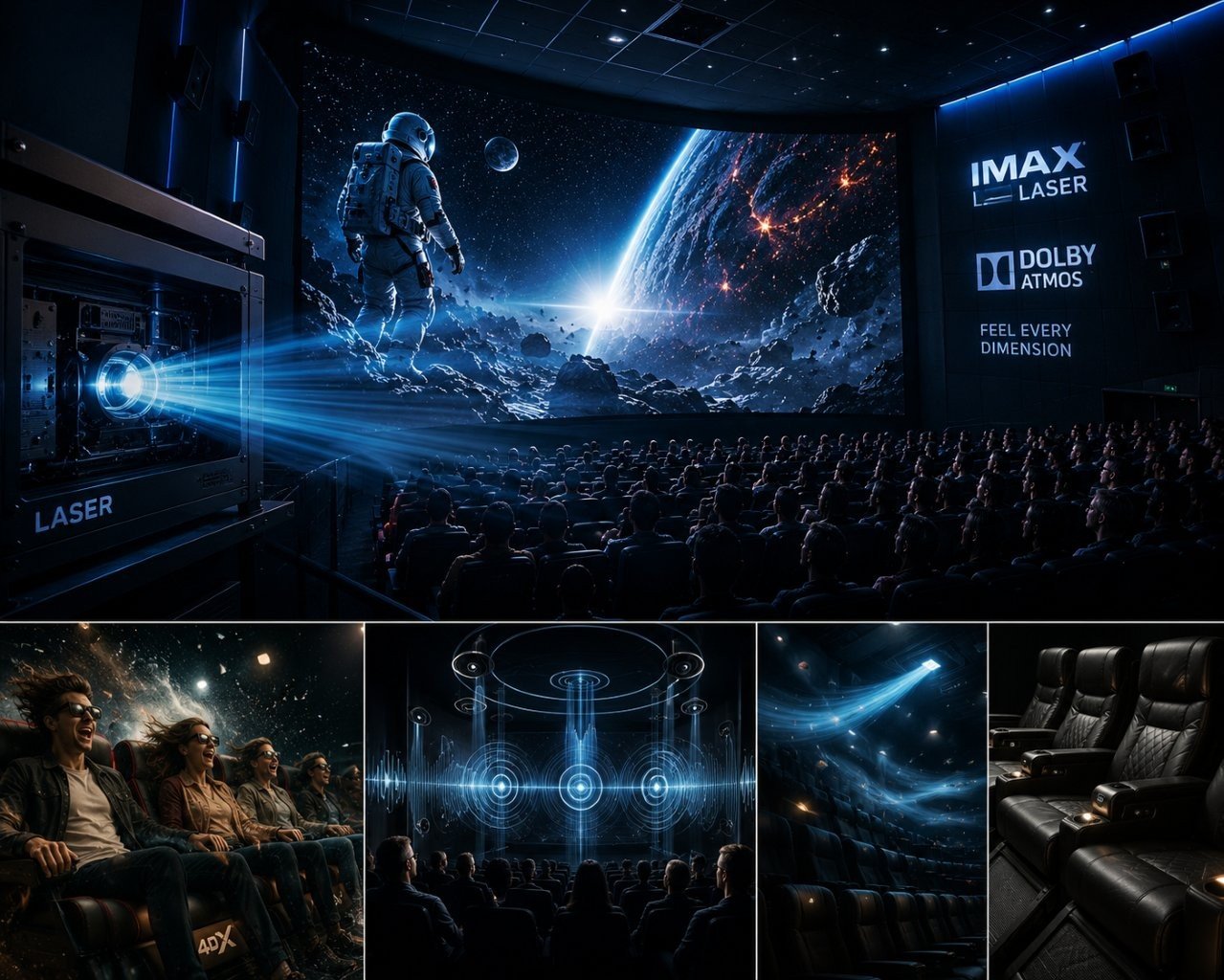
Next-Gen Cinema Tech: How Laser Projection and Spatial Audio Are Saving the Big Screen
As home theater setups, 4K displays, and streaming platforms become increasingly sophisticated, modern movie theaters face a clear challenge: offer an unparalleled visual and auditory event or risk irrelevance. In 2026, exhibitors are responding not by competing with home setups, but by radically transforming the theatrical experience into a high-tech, multi-sensory destination that cannot be replicated in a living room.
The modern big screen relies heavily on cutting-edge exhibition technologies. From crystal-clear laser projection systems to object-based spatial audio and physical sensory immersion, next-generation cinema technology is redefining why audiences go to the movies. Here is how advanced theater technology is preserving theatrical exclusivity and driving the future of cinema.
IMAX with Laser: The Pinnacle of Visual Clarity
Traditional xenon bulb projectors are quickly becoming obsolete in premium auditoriums, replaced by advanced dual-laser and single-laser projection systems. Laser technology offers unprecedented brightness levels, deep contrast ratios, and expanded color gamuts that reveal subtle details even in the darkest scenes.
Why Laser Projection Superiority Matters
- Unmatched Contrast Ratios: Dual-laser systems deliver pure, deep blacks alongside blindingly bright highlights, creating unprecedented image depth.
- Expanded Color Volume: Rec. 2020 color space capabilities allow audiences to view richer, more lifelike colors that traditional projectors cannot display.
- Massive Aspect Ratios: IMAX laser installations utilize expanded 1.43:1 and 1.90:1 aspect ratios, offering up to 26% to 40% more picture than standard digital screens.
Technology analysis published on The Verge notes that laser projection has become the single most vital upgrade for premium large-format screens seeking to justify premium ticket prices.
Spatial Audio and Dolby Atmos: The Sonic Revolution
Visual excellence is only half of the modern theatrical equation. The adoption of object-based spatial audio systems, such as Dolby Atmos, has elevated film sound from traditional surround sound channels into a dynamic three-dimensional sonic environment.
Key Advantages of Object-Based Spatial Audio
- Precise Sound Placement: Sound engineers place individual audio objects anywhere in the auditorium—including overhead—with pinpoint spatial precision.
- Custom Acoustic Calibration: Overhead speaker arrays and sub-bass impact systems are continuously tuned to optimize acoustics for every seat in the house.
- Visceral Low-Frequency Resonance: Next-gen subwoofers deliver sub-audible physical vibrations that make audiences physically feel explosions, music cues, and atmospheric tension.
In-depth audio engineering commentary from Sound & Vision highlights how spatial audio transforms passive viewing into an immersive, active sensory experience.
4DX and Multi-Sensory Physical Immersion
Beyond screen clarity and audio precision, high-tech theatrical formats like 4DX and ScreenX are turning moviegoing into an interactive amusement park ride. By synchronizing physical motion seats with environmental effects, these auditoriums offer physical engagement that home environments cannot match.
Sensory Elements Enhancing the Big Screen
- Motion-Synchronized Seating: Seats sway, pitch, and vibrate in real-time sync with on-screen camera movements and action sequences.
- Atmospheric Effects: In-theater wind, mist, fog, strobe lighting, and subtle scent generators deepen storytelling immersion.
- 270-Degree Panoramic Viewing: Multi-projection systems like ScreenX expand the movie onto side auditorium walls, wrapping around the viewer’s peripheral vision.
The Future of Theatrical Exclusivity
Next-gen cinema technology proves that the movie theater is not dying; it is simply evolving into an exclusive, event-driven experience. By offering state-of-the-art laser projection, spatial acoustic precision, and physical sensory immersion, cinema owners are ensuring that the big screen remains the gold standard for film presentation.