
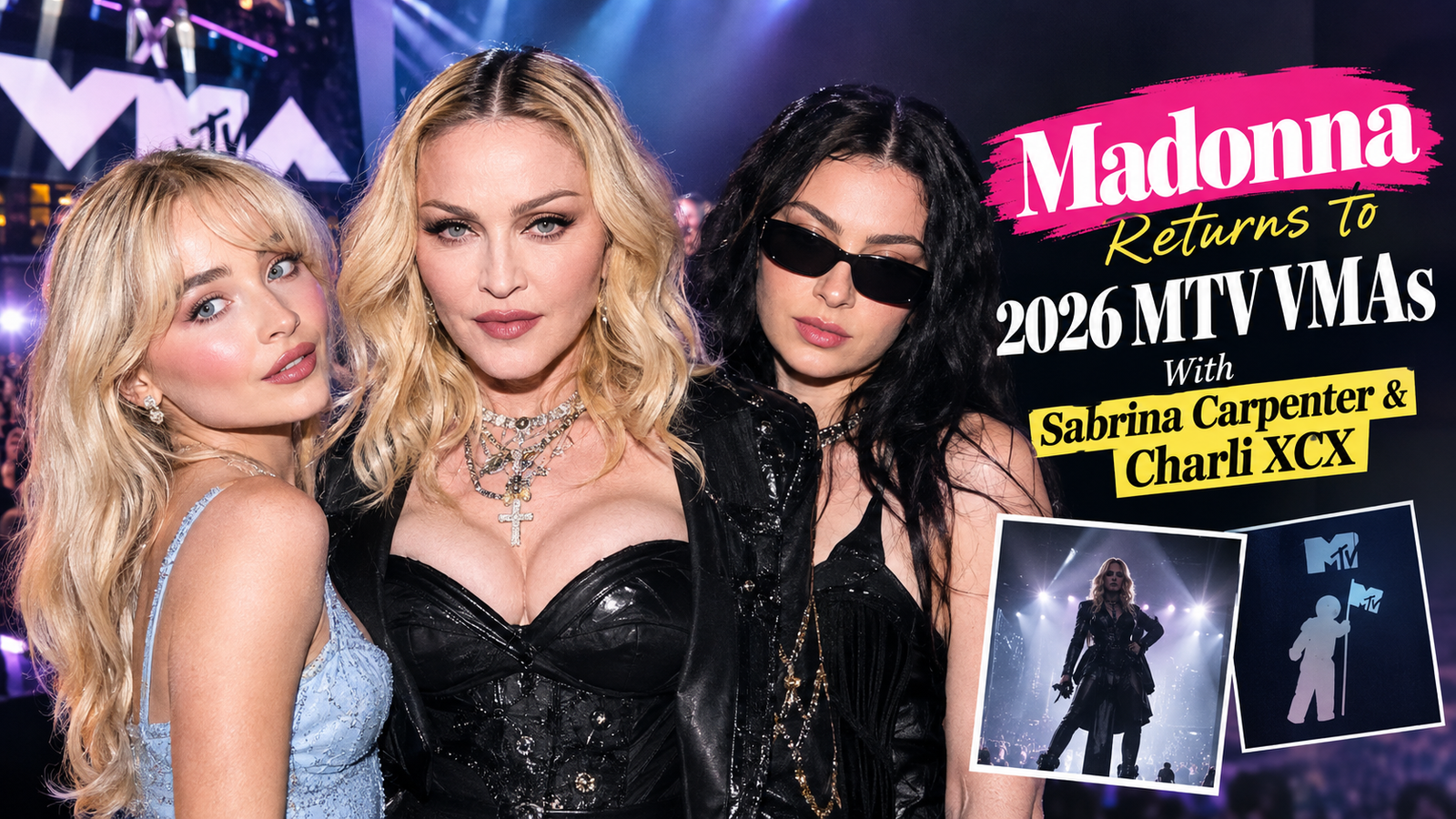
Madonna made her long-awaited return to the MTV Video Music Awards on September 27, 2026, opening the ceremony with a star-studded performance alongside Sabrina Carpenter and Charli XCX.
The Madonna 2026 MTV VMAs performance marked her first appearance on the VMA performance stage in 23 years. The ceremony took place at the Peacock Theater in Los Angeles and was hosted by Snoop Dogg.
Rather than simply revisiting her past VMA moments, Madonna used the performance to spotlight music from her latest album, Confessions II. The set combined new collaborations with the kind of theatrical production that has long been associated with her appearances at the VMAs.
Madonna Opens the 2026 MTV VMAs
Madonna kicked off the ceremony with Sabrina Carpenter joining her for “Bring Your Love,” a house-pop collaboration from Confessions II. The performance quickly moved from a staged piano sequence into a larger choreographed production.
The appearance was especially notable because Madonna had not performed at the VMAs since 2003. That earlier appearance became one of the show’s most remembered moments after Madonna performed with Britney Spears and Christina Aguilera.
Her 2026 return therefore connected a major chapter of VMA history with her current musical era.
Sabrina Carpenter Joins Madonna for “Bring Your Love”
Carpenter appeared early in the set for “Bring Your Love.”
The song comes from Madonna’s latest album, Confessions II, and had already placed the two artists together in the 2026 VMA nominations. MTV’s official listings included Madonna and Carpenter’s collaboration in the Best Collaboration category.
Their performance gave the opening number a clear connection to Madonna’s current music rather than making the comeback purely nostalgic.
Charli XCX Makes a Surprise Appearance
The performance then shifted when Charli XCX joined Madonna.
Charli performed “Danceteria Afterhours,” a remix of Madonna’s “Danceteria” from Confessions II. The surprise appearance added another contemporary pop star to Madonna’s VMA comeback.
According to Pitchfork’s report from the ceremony, the performance also featured appearances from Julia Garner, Debi Mazar, Sombr and Seth Rogen.
The combination of established and younger artists made the segment one of the night’s major talking points.
Madonna’s VMA History Made the Return Significant
Madonna’s relationship with the MTV VMAs goes back to the show’s earliest years.
She performed at the inaugural VMAs in 1984, delivering her famous rendition of “Like a Virgin.” She later became a Video Vanguard Award recipient and accumulated numerous VMA wins throughout her career.
Her 2003 appearance with Britney Spears and Christina Aguilera remains particularly associated with the ceremony’s history. In 2026, however, Madonna returned with new music and a new generation of pop collaborators.
That helped make the performance both a career callback and a promotion of her current era.
Madonna Was Also Among the Night’s Major Award Winners
Madonna’s return was not limited to the performance stage.
She won Artist of the Year at the 2026 MTV VMAs, adding another major VMA honor to her career. CBS News reported that she was among the night’s biggest award recipients, while Billboard reported that she finished the ceremony with seven awards.
Her collaboration with Sabrina Carpenter also won Best Collaboration, according to MTV’s official VMA results.
The 2026 ceremony also featured major recognition for Taylor Swift and Nirvana. Swift received the inaugural Artist Director Honors, while Nirvana was selected for the Video Vanguard honor.
Why Madonna’s 2026 VMAs Performance Stood Out
The Madonna 2026 MTV VMAs performance brought together several elements of the artist’s career.
First, it marked her return to the VMA performance stage after more than two decades. Second, it introduced music from Confessions II to a major live television audience. Finally, the appearances by Sabrina Carpenter and Charli XCX connected Madonna’s legacy with two prominent contemporary pop artists.
The result was a performance built around both history and new music rather than relying solely on nostalgia.