
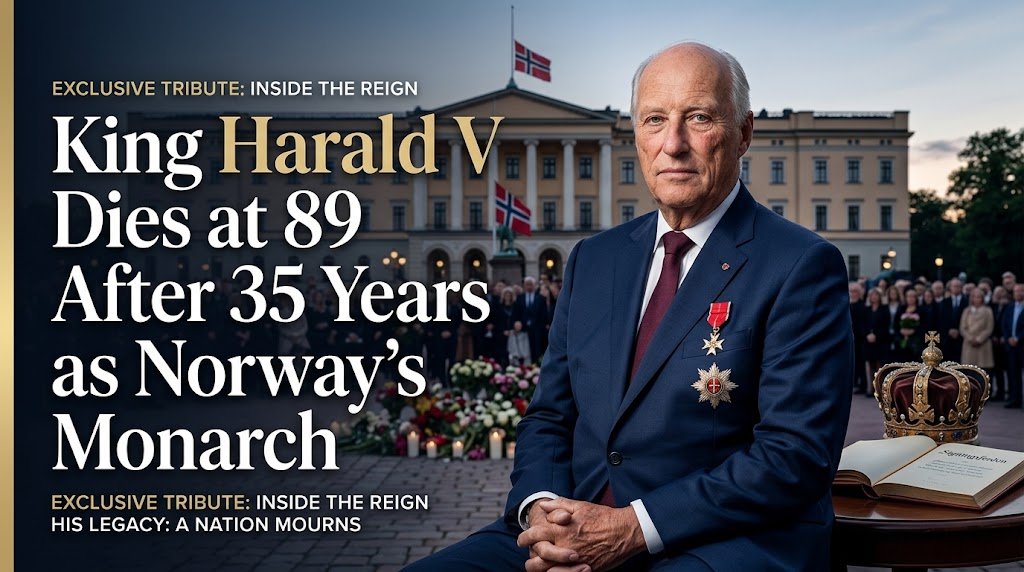
King Harald V Dies at 89 After 35 Years as Norway’s Monarch
King Harald V dies at 89, bringing an end to a 35-year reign that made him one of Europe’s longest-serving monarchs. Norway’s Royal Court announced that the king died peacefully at Oslo University Hospital Rikshospitalet on Friday, August 28, at 6:35 a.m.
The palace confirmed his death as Norway now enters a period of mourning and prepares for a change at the top of its constitutional monarchy. Harald’s only son, Crown Prince Haakon, has succeeded him as king.
Harald was 89 years old. He had been Norway’s monarch since January 1991, following the death of his father, King Olav V.
King Harald V Dies After a Long Reign
King Harald V’s reign lasted more than three decades. During that time, he became closely associated with a modern and approachable Norwegian monarchy.
The Royal Court describes the king’s role as primarily representative and ceremonial. However, Harald regularly appeared at important national events and met Norwegians during both celebrations and periods of national tragedy.
Reuters reported that Harald was widely respected for his warmth, humility and dedication to public service. Tributes began arriving from political leaders, royal families and other public figures following news of his death.
His death marks the end of an era for the Norwegian royal family.
What Happened to King Harald V?
The Norwegian Royal Court confirmed that King Harald died at Oslo University Hospital Rikshospitalet on August 28, 2026.
The palace gave the exact time of death as 6:35 a.m. local time. Its announcement described his passing as peaceful.
Reports before his death had focused on his deteriorating health and hospitalisation. Reuters reported that the king had been hospitalised after a bacterial infection.
The announcement prompted an immediate public response in Oslo and elsewhere in Norway, with people gathering to pay their respects to the late monarch.
Crown Prince Haakon Becomes Norway’s New King
With Harald’s death, the Norwegian throne passed immediately to his son, Crown Prince Haakon.
Haakon, born July 20, 1973, had served as heir to the throne for more than three decades. He is the son of King Harald and Queen Sonja.
Reuters reported that Haakon took the name King Haakon VIII after succeeding his father. His accession begins a new chapter for Norway’s royal family.
The transition does not mean that Norway is changing from a monarchy to another form of government. The country remains a constitutional monarchy, with the king serving mainly as a symbolic and representative head of state.
King Harald V’s Early Life Was Shaped by World War II
Harald’s childhood was deeply affected by World War II.
Born on February 21, 1937, at Skaugum in Asker, he was the son of Crown Prince Olav and Crown Princess Märtha. His grandfather was King Haakon VII.
When Germany invaded Norway in April 1940, the royal family was forced to leave the country. Harald and his sisters first went to Sweden with their mother before travelling to the United States.
The family spent part of the war years in America. Harald returned to Norway in 1945 after the end of the German occupation.
His experiences during those years formed an important part of the story of a future king who would later represent Norway for decades.
From Military Training to the Norwegian Throne
After returning to Norway, Harald continued his education there. He attended Oslo Cathedral School and later completed military training, graduating from the Norwegian Military Academy in 1959.
He subsequently studied at Balliol College, Oxford, where he focused on social science, history and economics.
Harald became Crown Prince after his grandfather, King Haakon VII, died in 1957. He gradually assumed more official responsibilities and eventually became king following the death of King Olav V in January 1991.
He formally swore an oath to uphold Norway’s Constitution several days later. Harald and Queen Sonja were later consecrated at Nidaros Cathedral in Trondheim in June 1991.
King Harald’s and Queen Sonja’s Historic Marriage
One of the defining parts of Harald’s personal story was his marriage to Sonja Haraldsen.
The couple married at Oslo Cathedral in 1968 after years of courtship. Sonja was a commoner, making the relationship notable within the traditions of European royalty.
When Harald became king in 1991, Sonja became queen of Norway. The royal court notes that she had already served as Norway’s first lady since their marriage in 1968.
Together, Harald and Sonja had two children: Crown Prince Haakon and Princess Märtha Louise.
Their family later expanded to include grandchildren, including Princess Ingrid Alexandra and Prince Sverre Magnus.
A Monarch Known for Modernizing the Royal Family
Harald’s approach to the monarchy was often viewed as more modern than that of earlier generations.
He and Queen Sonja maintained a visible public presence while also allowing the royal family to become more connected with ordinary Norwegian society.
Harald also became known for speaking about equality, inclusion and tolerance. His public comments on diversity and LGBTQ+ rights were widely noted during his reign.
At the same time, his role remained largely constitutional and ceremonial. The Norwegian Royal Court explains that the king represents the country and performs formal duties, while executive political power is exercised through the constitutional system and government.
Harald’s Passion for Sports and the Environment
Outside his constitutional duties, Harald had a strong interest in sports and nature.
Sailing was one of his greatest passions. He competed internationally and represented Norway at the 1964 Tokyo Olympics, where he carried the Norwegian flag at the opening ceremony.
The Royal Court also records that Harald and his crew won the world championship in 1987 and the European championship in 2005. He continued competing in sailing events until 2022.
He was also involved in environmental causes. As Crown Prince, Harald helped establish the Norwegian branch of the World Wide Fund for Nature and served as its president for two decades.
These interests gave the king a public identity that extended beyond royal ceremonies.
Norway Mourns the Death of King Harald V
News of King Harald V’s death has prompted tributes from inside Norway and around the world.
Reuters reported that international leaders praised his decades of service, while Norwegian figures highlighted his ability to connect with people and provide a sense of continuity during difficult moments.
His death also comes at a significant moment for the Norwegian monarchy. Haakon now takes on the responsibilities his father carried for 35 years, while Haakon’s daughter, Princess Ingrid Alexandra, moves into a new position in the line of succession.
For many Norwegians, however, the immediate focus remains on remembering Harald.
He was born before the Second World War, grew up through Norway’s wartime experience and eventually became a monarch who remained on the throne through enormous social and political change.
King Harald V’s death therefore closes not only a long royal reign but also a remarkable chapter in modern Norwegian history.