
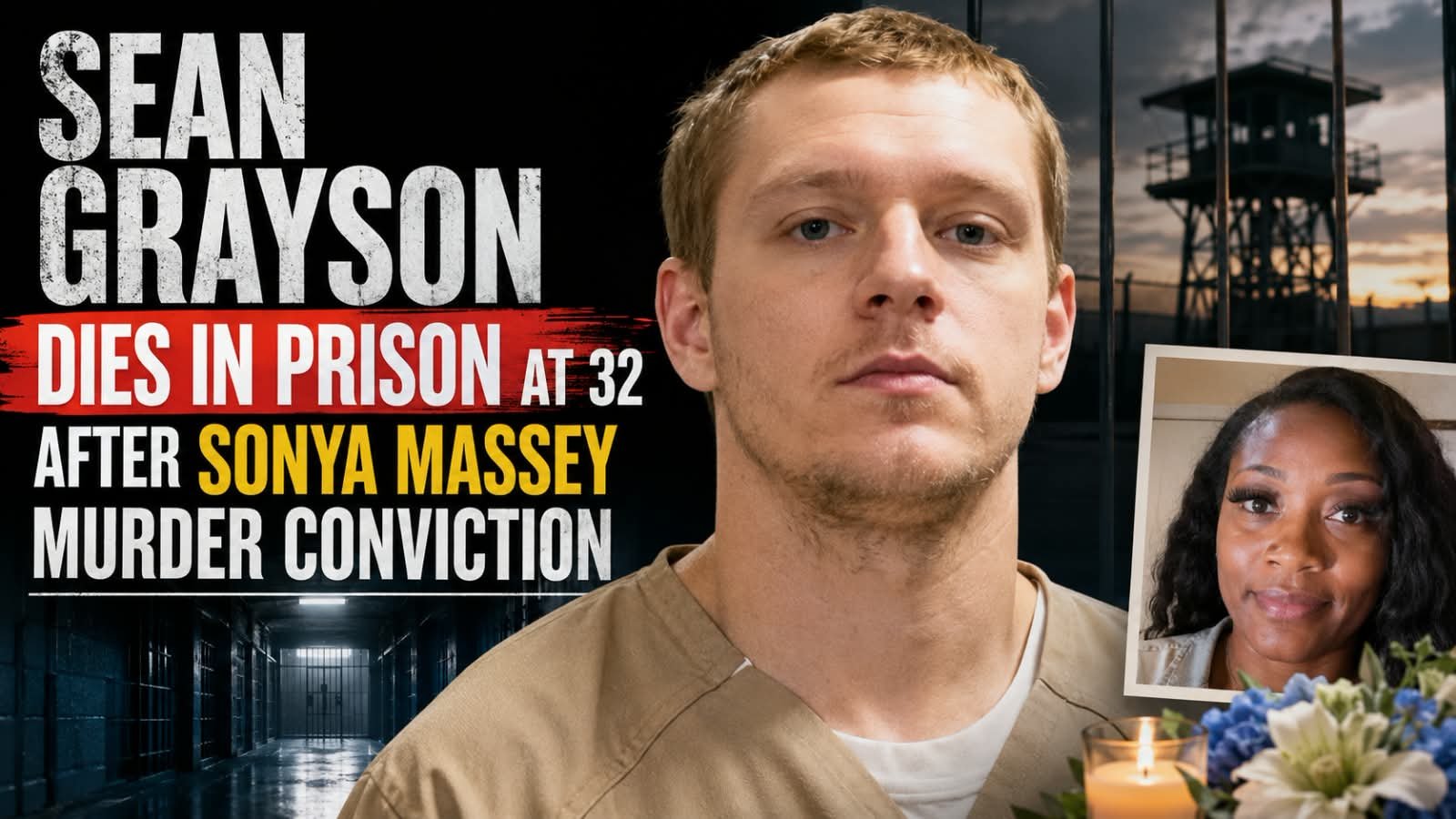
Sean Grayson dies while serving sentence for Sonya Massey’s killing.
Sean Grayson, the former Sangamon County sheriff’s deputy convicted in the killing of Sonya Massey, has died at age 32 while serving a 20-year prison sentence.
Grayson’s attorney, Daniel Fultz, confirmed his death on Aug. 23, 2026. The Illinois Department of Corrections later confirmed that Grayson died while in custody at a facility outside Illinois, although officials did not release additional details about the circumstances.
Grayson had been convicted of second-degree murder in October 2025 for the fatal shooting of Massey, a 36-year-old mother of two. He had served only part of his sentence before his death.
His death comes weeks after the Illinois Prisoner Review Board rejected his request for medical release. Grayson had been battling advanced colon cancer, which had spread to other parts of his body.
Why was Sean Grayson in prison?
Grayson was serving a 20-year sentence for the July 2024 killing of Sonya Massey at her home in Springfield, Illinois.
Massey had called 911 shortly before the shooting because she believed there could be a prowler outside her home. Grayson and another deputy responded to the call.
Body-camera footage from the encounter later became central to the criminal case. The footage showed the deputies entering Massey’s home and interacting with her in the kitchen.
During the encounter, Massey picked up a pot containing hot water. Grayson later argued that he believed she posed a threat and that he acted in self-defence.
The other responding deputy, however, testified at trial that he did not view Massey as a threat.
Grayson ultimately fired his weapon, striking Massey. She died at a Springfield hospital later that morning.
Sean Grayson was convicted of second-degree murder
Prosecutors initially charged Grayson with first-degree murder, aggravated battery with a firearm and official misconduct.
At trial, Grayson pleaded not guilty and maintained that he feared for his safety during the confrontation.
After deliberating for roughly 12 hours, jurors rejected the first-degree murder charge but found him guilty of second-degree murder. He was sentenced to 20 years in prison in January 2026.
The conviction followed months of intense public attention surrounding Massey’s death. The case sparked protests and renewed discussions about police accountability, use of force and how law enforcement responds to people experiencing mental-health crises.
Grayson’s cancer diagnosis and medical release request
Grayson’s health had become an important part of his legal proceedings.
According to court records reported by Capitol News Illinois, doctors diagnosed him with colon cancer in 2023, before the shooting. His attorneys later said the cancer had advanced and spread to his liver and lungs.
While incarcerated, Grayson continued receiving medical treatment.
In 2026, his legal team sought compassionate or medical release because of his worsening condition. The Illinois Prisoner Review Board denied the request in July, only weeks before his death.
The decision became another point of discussion surrounding the case, particularly because Grayson was already serving a lengthy sentence for Massey’s killing.
Sonya Massey’s family responds to Grayson’s death
Massey’s family has continued to emphasise that Grayson’s death does not undo the loss caused by her killing.
Attorneys Ben Crump and Antonio Romanucci, who represented the Massey family, released a statement after Grayson’s death.
They expressed sympathy for those mourning Grayson while stressing that Massey’s death had permanently affected her family.
For Massey’s loved ones, the case was never only about the criminal sentence. Her death left behind two children and a family that had spent years seeking accountability.
The Sonya Massey case changed the conversation about police accountability
The shooting received national attention because Massey had contacted police for help before she was killed by one of the officers who responded.
The case also contributed to legislative and policing changes in Illinois. The Sonya Massey Act introduced additional requirements involving background checks and employment history reviews for law-enforcement applicants.
The U.S. Department of Justice also became involved in reviewing policing practices in Sangamon County. Subsequent reforms addressed areas including officer training and responses involving people with behavioural-health needs.
As a result, the impact of the Sonya Massey case has extended beyond the courtroom and into broader debates about police hiring, accountability and crisis response.
What happens next in the Sonya Massey case?
Sean Grayson’s death ends the possibility of him serving the remainder of his 20-year sentence. However, the broader issues raised by Massey’s killing remain part of ongoing discussions about policing and public safety.
Massey’s family continues to grieve her death, while the policy changes connected to the case are now part of Illinois’ approach to law-enforcement oversight.
Grayson’s death also highlights the complicated intersection of criminal punishment and serious illness. His unsuccessful medical-release request had been decided only weeks before he died.
For those following the case, however, the central fact remains unchanged: Sonya Massey called 911 for help in July 2024 and did not survive the encounter with responding law enforcement.